
On 14 February 2024 the British Columbia Civil Resolution Tribunal made Air Canada pay a passenger CAD 812.02 because the airline’s chatbot had quoted a bereavement-fare refund policy that did not exist. Air Canada’s defence was that the chatbot was, in the tribunal’s paraphrase, “responsible for its own actions”. The tribunal rejected it. The brand owns what the bot says.
Every South African brand currently running a customer-facing chatbot, an AI assistant on a help centre, or an AI-trained tool inside a contact centre has been operating on the quieter version of that defence. SA contract law, the Consumer Protection Act, and POPIA all cut the same way as the BC tribunal did. The legal shadow has already crossed our border. Most SA legal teams have not run the audit.
What did the Air Canada tribunal decide?
Jake Moffatt asked Air Canada’s website chatbot about bereavement-fare refunds the day his grandmother died. The chatbot told him he could book at full fare and claim a partial refund within 90 days. He did. Air Canada then refused the refund and pointed him at the actual policy, buried elsewhere on the site, which said bereavement fares had to be requested before travel. Moffatt sued for the difference and won.
The award was small. The reasoning is the part that matters. The tribunal said Air Canada was “remarkable” in suggesting that its own chatbot was a separate legal entity responsible for its own actions. The chatbot lives on the website, which lives in the brand’s control; that is the whole argument. The decision is Moffatt v. Air Canada, 2024 BCCRT 149, published openly on CanLII. It is short, plain-English, and worth reading once before any further conversation with your legal team about AI surfaces.
Does the same logic apply in South Africa?
Yes. The doctrines have different names but the same shape. SA contract law recognises ostensible authority. If a brand puts a representative in front of the customer in a way that looks authoritative, the brand is bound by what that representative says. A chatbot on the brand’s own domain, branded in the brand’s colours, answering in the first person, is the textbook fact pattern for ostensible authority.
The Consumer Protection Act 2008 adds a second floor. Section 41 prohibits false, misleading or deceptive representations in the marketing or supply of goods or services, and it does not care which tool produced the representation. The National Consumer Commission has not yet ruled on an AI-output case. The wording leaves it almost no room to rule the other way when one arrives.
What does POPIA say about AI-generated outputs?
Section 71 is the one I would lead with. It governs automated decision-making that produces a legal effect for the data subject. Refusing a loan, denying cover, sizing a claim. A brand cannot subject a customer to a purely automated decision of that kind without consent, a contract, or a law requiring it. Many SA chatbots quietly cross this line when they quote eligibility rules without anyone in legal having looked at the prompt template.
Section 16 is the quieter, broader one. The accuracy obligation says personal information you process must be complete, accurate, up-to-date and not misleading. An AI surface that names a customer’s entitlement and gets it wrong is processing inaccurate personal information about them. That is a structural compliance failure, not a customer-service mistake.
Where I genuinely do not know is the timing. The Information Regulator’s enforcement focus through 2025 sat on breach notification and direct marketing, not on AI outputs. The Regulator has signalled AI as a focus area in public statements but has not published a generative-AI guidance note. The conservative read is that 2026-27 will close that gap and the audit you do now is the audit you would do anyway. The other read is that enforcement priorities slide. I would not bet a customer complaint on the second read.
You cannot audit what you have not measured. Start with what AI is already saying about your brand. The free Brand Scorecard returns your blind visibility, your complaint-platform exposure, and the top three sources GPT-5, Claude and Gemini cite when they describe you. About a minute, one email, no demo gate.
What about ChatGPT or Gemini saying something wrong about my brand?
This is the harder case. A third-party AI is not your tool, not under your contract with the customer, and not under your control. The ostensible-authority argument does not run the same way. Defamation might, depending on whether the statement is identifiable as a statement of fact and demonstrably false. The South African defamation bar is set by National Media Ltd v. Bogoshi 1998 (4) SA 1196 (SCA), which gives publishers a reasonable-publication defence. Whether OpenAI, Anthropic or Google could claim that defence over an LLM output is unsettled and probably will be for years.
The practical fix is different from the legal fix. You can’t sue ChatGPT into accuracy. You can measure what it says about you, you can correct the underlying sources it draws from, and you can publish primary information in places those models will cite. The bench data shows the SA sources AI reads are concentrated on a short publisher list. That short list is the lever.
What should a South African brand do this quarter?
The audit is the work. The audit is also the easiest part of the work to start. One week, one product owner, one shared document.
One — list every AI surface. Walk your domain. Open the help centre. Open the app. Talk to whoever runs marketing ops about AI copy tools. Talk to the support team about internal assistants. The audit usually surfaces three or four AI surfaces the legal team did not know existed.
Two — capture what each one is saying. Screenshot the outputs across twenty common customer questions per surface. Date-stamp the screenshots. This is the evidence file you will wish you had when the first complaint lands.
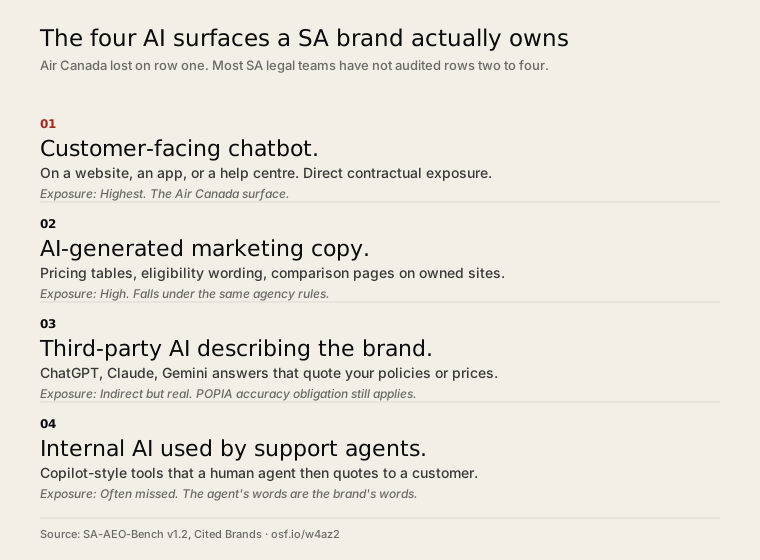
Three — classify the exposure. Use the four-row ladder above. Anything that quotes price, policy or eligibility gets the priority queue. Anything that names competitors gets a second queue. Anything that processes personal information about a named customer goes to the Information Officer the same day.
And then the part that the Air Canada decision rewards: write a short, plain-English disclosure on each AI surface saying the brand is responsible for the outputs and naming the human path for escalation. Air Canada lost partly because the chatbot looked like the company and partly because it pretended not to be. A disclosure does not waive liability. It does change the customer’s next step from a lawsuit to a phone call, which is usually where you wanted them in the first place.
Frequently asked questions
Does the Moffatt decision actually bind a SA court?
No. It is a Canadian small-claims-equivalent decision and SA courts are not bound by it. SA courts are bound by SA contract law, the Consumer Protection Act and POPIA, all of which point the same way on the underlying question. Moffatt is persuasive, not authoritative. A SA brand relying on “the chatbot spoke, not us” is relying on a defence the underlying SA law was never going to accept either.
Our chatbot has a disclaimer saying outputs may be inaccurate. Does that protect us?
Partially and unevenly. Disclaimers can shift some risk but cannot contract out of Consumer Protection Act protections, which are mandatory for transactions with a consumer. They also cannot contract out of POPIA’s accuracy obligation, which exists independently of the contract. A disclaimer is a sensible part of the risk-management stack. It is not the whole stack and it does not replace the audit.
Is this a problem only for big brands?
No. The exposure scales with the customer base, not the brand size, and the audit cost is the same either way.
Do we need outside counsel for the audit?
Not for the first pass, and this is the part where I think most SA brands waste money. Internal Marketing Ops plus the Information Officer can run the surface inventory and the screenshot capture in a week. That step does not need a partner billing hour. The work that does need counsel is the classification step: which outputs touch section 71 automated decision-making, and which touch material terms of the customer contract. That is where the legal judgement matters, and where generic GC advice will not be enough either — section 71 cases will turn on how the brand framed the output, who saw it, and whether the customer reasonably understood it as definitive. Hire counsel who has actually read the POPIA codes, not just the Act itself. The signal that you have the right counsel is that they push back on at least two of your audit classifications; the signal that you have the wrong counsel is that they sign off on all of them in the same meeting.
How does this connect to AI search reputation, which is what Cited Brands measures?
The two problems share a root. A brand that has not audited what its own AI surfaces say has almost certainly not measured what third-party AI says either. Both audits start with capturing outputs, classifying them, and feeding back to the source. The Brand Scorecard does the third-party half: what GPT-5, Claude and Gemini say about you, sourced and dated. The owned-surface audit is a different project, but the discipline is the same.
A note on what we do not yet know. The Information Regulator has signalled AI as a focus area but has not yet published a guidance note specifically on generative AI outputs and section 71. The first such note will probably reshape the audit checklist above, and we do not know which way. The conservative position for now is to audit as though the guidance is already strict, because the underlying provisions already are. If you want our cut as it develops, the Q2 2026 Index Report tracks the regulatory layer alongside the citation data.
Last updated 26 May 2026. Methodology open at osf.io/w4az2. This post is editorial commentary on public legal materials, not legal advice — talk to your own counsel before acting on it.