There is a specific moment in a budget review when an AI-search proposal dies, and it is not when the CFO asks her first question. It is the second slide. By then the CMO has already lost the room — because the first slide opened with a ChatGPT screenshot, or the word AEO, or a definition. The CFO has filed the request under “discretionary, ask again next quarter”. The fix is the first slide.
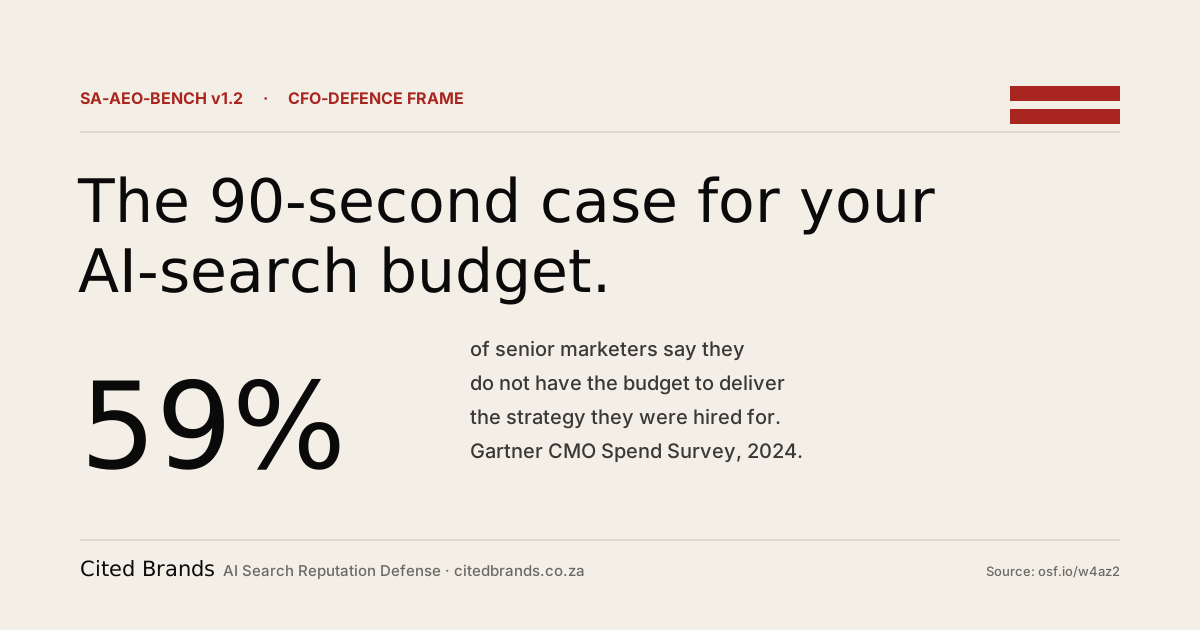
Gartner’s 2024 CMO Spend Survey put 59% of senior marketers as unable to fund the strategy they were hired to deliver. The figure is probably an undercount — that survey skews toward enterprise respondents, where the gap is narrower than it is at the scale-up end — but the direction is right. The CMO walking into a 2026 budget meeting needs the frame the CFO already runs in her own head. That frame is not “spend on this new channel”. It is “what is this leak costing us”. Same math, opposite sign.
Why does the CFO conversation kill more AI-search budgets than any other gate?
Because the proposal arrives in the wrong shape. The CMO walks in with a slide about ChatGPT, Claude and Gemini, and the CFO hears a vendor pitch. She cannot size the risk, she cannot tie it to anything she already tracks, and in 2026 the SA CFO has more direct say over the marketing budget than at any point in the last decade (Forrester / Financial Mail, 2026). Most AI-search budgets die in that room, in the first ninety seconds, before the second slide.
The fix is the opening sentence. It has to be a cost — paid in rands, denominated in lost consideration set. Once that opens the slide, every later question (what is AEO? how does ChatGPT cite?) becomes a follow-up rather than a gate. The category education can happen later, with whoever ends up owning the work.
What goes in the 90 seconds?
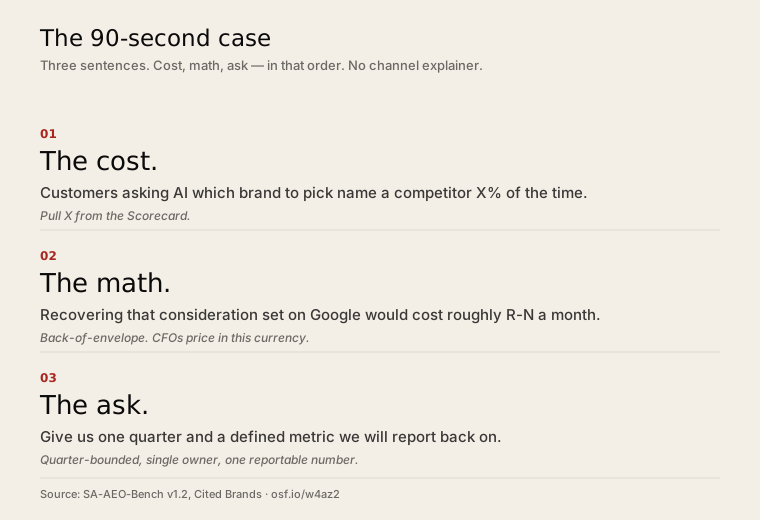
Three sentences, in this order.
One — the cost. “When South African customers ask ChatGPT, Claude or Gemini which {category} to pick, our brand is named a measured share of the time. The rest of the share names a competitor.” The exact share comes from the Scorecard. State it. Do not soften it.
Two — the math. “Recovering that consideration set on Google search would cost roughly R−N a month at our current paid-search CPC.” This is a back-of-envelope number and CFOs know to discount it. The point is the currency, not the precision. (More on the math below.)
Three — the ask. “Give us one quarter and a defined number we will report back on.” Quarter-bounded asks with a reportable metric clear the CFO threshold materially more often than open-ended programme asks. Bound the spend, bound the time, name the metric.
You need a real number for sentence one. The free Brand Scorecard returns your blind visibility across all three models in about a minute. No demo. No upsell stack.
How do you actually compute the cost-of-inaction number?
Three inputs, multiplied.
First, your blind visibility — the share of open-ended category prompts that name your brand without being asked about you by name. This comes from the Scorecard, or from running the prompts manually across the three models if you want to do it yourself first. Use a low figure as the working number if you have not measured yet; you can fix the estimate next quarter.
Second, the volume of category queries now routed through AI assistants rather than through Google. Conductor’s 2026 CMO Investment Report put 94% of CMOs as actively increasing AEO and GEO investment, with 97% reporting positive impact. The 97% is almost certainly inflated — nobody who has just approved AEO spend is going to tell a survey their own decision isn’t working — but even halved, the underlying signal is real. eMarketer puts a meaningful slice of SA category research now happening inside AI assistants instead of on a Google results page.
Third, the cost-per-click you would pay to recover that consideration set via paid search. Pull your own Google Ads CPC for the category. If you do not run paid, use the SA median for your industry — insurance runs roughly R30 to R60, banking R20 to R40, medical aid R40 to R90.
Multiplied together you get a monthly rand figure of paid-equivalent reach the gap is effectively burning. The math is rough. There is no good public number for what share of SA category research is currently routed through AI assistants, and our own internal estimate (running somewhere in the low-teens-to-low-twenties percentage band across the categories we measure) carries a chunky confidence interval. Even with that, a SA brand with low blind visibility in a category whose CPC averages R40 and whose AI-routed share sits in the middle of that band lands at a leak in the low six figures of rands a month. That is the kind of number that gets a CFO’s attention, even when it is rough.
The full category-by-category worksheet, with the bench’s SA category-level visibility benchmarks built in so a CFO can stress-test the assumptions herself, sits inside the Q2 2026 Index Report.
What number do you bring into the meeting?
A measured one, not an estimated one. CFOs trust numbers with provenance: who measured it, when, against what reference. The bench ran a hundred SA brands across twelve industries on three frontier models — pre-registered at osf.io/w4az2 in advance of data collection, methodology open, third-party-replicable for under R30,000. The Scorecard puts your brand’s slice against that reference.
If the CFO pokes at the number, the answer is: it was measured the same way every other SA brand in the bench was measured. Same prompts, same models, same week. That answer holds up.
What if the CFO still says no?
Two fallback asks she is less likely to refuse, and one she will probably also refuse but is worth trying anyway.
Run the Scorecard, report back in 30 days. No spend, just a diagnostic. The output is one page she can take to her finance committee. Removes the “we do not have the baseline” objection that will kill the bigger ask next quarter as well.
Redirect a slice of an existing line. Paid social or brand awareness for one quarter. Does not ask for new money. Lets the CFO see whether the reported-back metric moves before she signs off on more.
The third move is honest: hand over the public bench data and ask for nothing in that meeting. Most SA CFOs have not seen a pre-registered AI-citation dataset before, and seeing one reframes the conversation away from “is this measurable”. It still might not work in this quarter. It changes the next conversation, though, even if it loses this one.
What should a South African brand actually do this week?
Run the Scorecard. Five minutes. The CMOs losing this meeting are the ones walking in with an idea instead of a number.
Then — and this is the line that matters — drop the channel frame entirely. Budget review is the wrong room for a category explainer. Save the AEO education for whoever ends up owning the work after the budget clears. The CFO does not need to learn ChatGPT to approve a spend that reduces a measured leak.
The third thing is mostly defensive. Name the methodology before the CFO asks. When she pokes at where the benchmark came from — and she will — you want a public, pre-registered protocol on hand. SA-AEO-Bench is one. There will be more by 2027. The point is to have an answer that doesn’t start with the word “we”.
Frequently asked questions
Doesn’t this just shift the same argument to a different name?
The argument changes from “fund a new channel” to “recover an existing leak”. CFOs read those very differently. The first is a discretionary spend decision, judged against other discretionary spends. The second is a leak-repair decision, judged against the size of the leak. Leak-repair decisions clear faster and at higher amounts.
What if the CFO doesn’t believe AI search has the volume to matter yet?
Bring external data, not internal estimates. Conductor 2026 put 94% of CMOs as actively increasing AEO/GEO investment, with 97% reporting positive impact (note: the 97% is self-reported, so halve it before quoting). eMarketer’s zero-click reporting documents the traffic shift in primary numbers. Combine those with the Scorecard’s measurement of where your brand sits today. The combination is harder to argue down than either piece alone.
How is this different from just running “better SEO”?
SEO ranks pages on a results list and lets the customer choose. AEO is the answer the customer sees instead of a list. A brand can rank number one organically and never appear in the AI summary that now answers most questions in the category. The two disciplines reinforce each other but they are not the same channel and they are not the same measurement.
Is the bench methodology peer-reviewed?
Pre-registered at osf.io/w4az2 in advance of data collection. Not peer-reviewed yet — the field is too young for that pipeline, and journal cycles run twelve to eighteen months behind the model releases. The protocol is open and replicable, which is the falsifiability standard that matters in practice. Any third party can re-run the bench against the same prompts and check the figures for the same budget.
We don’t fully understand AI search yet — should we wait until the dust settles?
Wait too long and the consideration set re-forms without you. The SA brands that started measuring in 2025 are now the names the AI defaults to when consumers ask category-level questions. That consideration set is sticky — once an AI has a stable answer shape for a category, the brands inside it compound. The cost of waiting is not zero. It is the position the brand who measured this year is taking.
One last thing, which doesn’t fit anywhere above and I keep meaning to write up properly. The cost-of-inaction frame works the way I’ve described it as long as AI assistants are still recommending. The minute they start transacting — and Stripe’s shopping-mode launch in late 2025, plus OpenAI’s commerce moves, both point that way — the multiplier changes shape, not just size. I haven’t worked out the new shape yet. Next quarter, probably. If you’re sitting in a budget review with a CFO who has read the news, expect a question about it, and the honest answer is “we don’t know yet, but it’s bigger, not smaller”.
Last updated 24 May 2026. Built on SA-AEO-Bench v1.2 (Cited Brands) — pre-registered at osf.io/w4az2. Refreshed quarterly.