Open ChatGPT today and ask where to buy a kettle online in South Africa. The answer it composes names two or three retailers, then routes the rest of the citation to Trustpilot, Amazon and a generic global comparison site. The customer never sees a results page. They see the answer. That is the funnel now, and for a SA retailer the math underneath is uglier than the global zero-click number suggests.
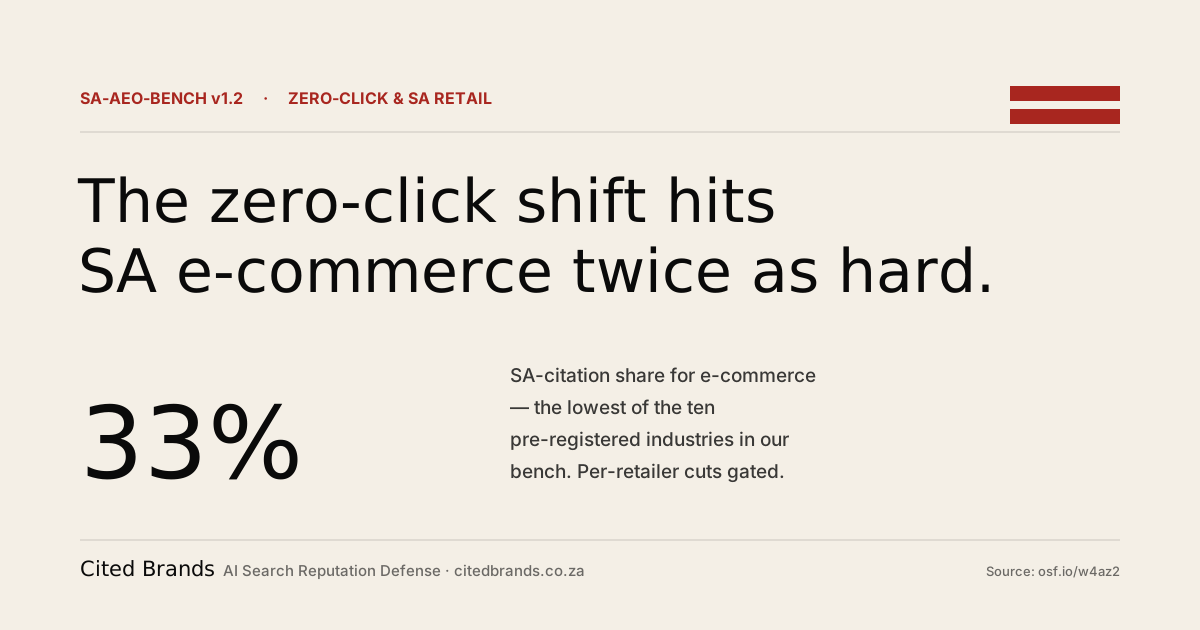
Industry estimates put zero-click at well above half of all Google queries in 2025–26 — Bain and SparkToro both land in that range, eMarketer’s slice runs a little lower, and SEO press has been printing the 60% line for two years. The headline is real. What the headline misses is that the cost doesn’t land evenly. Two effects stack against SA e-commerce specifically: the industry has the lowest SA-citation share of any pre-registered industry in our bench at 33%, and AI’s default sourcing for SA-retail prompts is built on international review platforms before it reaches for a local press domain. The exposure is asymmetric. The Q2 2026 Index Report has the per-retailer breakouts. This post is the shape.
What does zero-click actually do to a SA retailer’s funnel?
Two things, in sequence. First, the customer asks a category question and the assistant composes an answer instead of pointing to a list of ten blue links. Second, the answer names a small handful of brands and cites a handful of sources. If your brand isn’t in the answer, you weren’t considered. If your domain isn’t in the citation list, the model has no reason to update its description of you next time it’s asked.
That is the whole story, at a high level. The funnel collapses from impression → click → landing page into a single rendered sentence. The CMO loses two reflexes she has been trained on for fifteen years: ranking-as-distribution, and SERP-feature optimisation as a real channel.
Why is e-commerce the worst-hit SA industry?
Because AI treats SA online retail as a regional slice of a global category. The international review surfaces set the citation surface by default. The why-this-happens analysis — and the per-industry detail across the other nine pre-registered industries — sits in the Index Report.
| Industry | SA-citation share | Read |
|---|---|---|
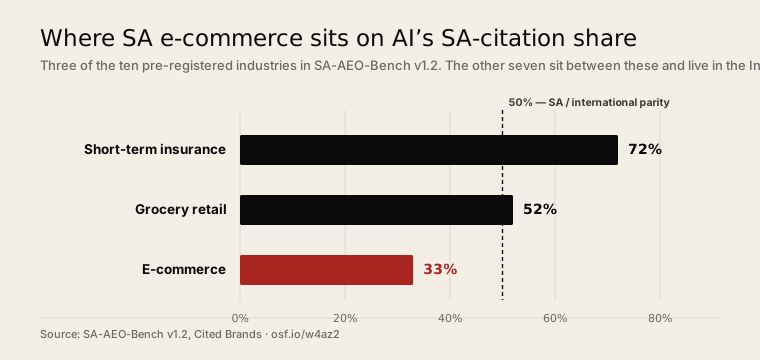
| Short-term insurance | 72% | AI reaches for local first. |
| Grocery retail | 52% | Roughly even, drifts on price-comparison prompts. |
| E-commerce | 33% | AI defaults international. |
Three rows, not the full ten. The other seven sit between these and live in the report. The point is the gap: an SA insurance brand is starting roughly twice as far up the slope as an SA e-commerce brand when the assistant gets the question.
Takealot’s 96% — and what it doesn’t protect against.
Takealot is named in 96% of blind e-commerce prompts across the three models. That is the highest single-brand visibility in the category and one of the highest across the entire 100-brand bench. By any read of the data, the brand is consensus.
It still loses citation share to international sources on most prompts where the user asks for proof, reviews, comparisons or alternatives. Named-recall and citation-surface are two different scoreboards. The Index Report breaks both out per retailer.
The brand keeps the consideration. The narrative slides.
Where does your retailer sit relative to Takealot’s 96%? The free Brand Scorecard returns your blind visibility, your top three cited sources across GPT-5, Claude and Gemini, and the international leak on your category prompts. One email, no upsell stack.
Where does the international citation actually come from?
Trustpilot leads, by a margin large enough that the ranking holds in every monthly bench cut we’ve done. Reviews.io is the second regular name. Beyond those two the citation tail spreads through Wikipedia, SimilarWeb and a handful of global comparison sites whose SEO is built specifically to capture “best X 2026” queries. The exact counts and the full international top 10 sit in the Index Report — giving away the publisher-by-publisher numbers in public posts erodes the report’s reason to exist.
What is worth saying here, in shape: AI cites the top international retail-review platforms more often than the top SA publishers combined when the prompt is about SA e-commerce. That ratio is the asymmetry. It is also the lever — the work is on the international surfaces, not on SA PR.
The Reddit thing for retail prompts.
On identical SA-retail prompts in the same week, Gemini cites Reddit hundreds of times. GPT-5 and Claude cite it zero. I can account for the ChatGPT zero — OpenAI’s grounding mix changed in late 2025 and Reddit’s share across all OpenAI surfaces fell. I can’t fully account for the Claude zero. The cleanest hypothesis is that Anthropic treats community forums as low-trust evidence by default for commerce queries, but that’s a guess. Either way, the practical answer is the same: your Reddit presence reaches Gemini users and almost nobody else. Allocate accordingly.
If I had your job at a SA retailer for one quarter.
Three moves, in order of leverage. The first two are unglamorous and the third is the one most retailers reach for first and shouldn’t.
One — make the international platforms cite you well. The leverage point in this category is the international review surface, not SA PR. The first quarter’s budget belongs there, not on a SA PR retainer and not on more paid search. The playbook for how to actually do that work sits inside the Index Report — it isn’t a one-paragraph fix and pretending it is helps nobody.
Two — produce one piece of category content per month that the global aggregators link to. The aggregators reach for ranking-style content (“best wireless earbuds in South Africa 2026”) because that is what their own SEO needs. Give them something to lift. The citation flows back to your domain when they do.
And there’s a third move that gets a lot of marketing-meeting attention and almost no measured return: trying to get businesstech or mybroadband to write about your brand directly. SA business press helps on banking, medical aid and insurance prompts — it does not move the needle on e-commerce prompts, because AI doesn’t weight SA business press heavily in this category. The international review platforms are the leverage point in e-commerce. Save the press budget for a category where it actually compounds.
The Q2 2026 Index Report has the per-retailer leaderboard, the international citation top 10 with counts, the cost-of-inaction frame for a SA retail CFO, and the category-recovery playbook.
Frequently asked questions
Is this really different from the SEO problem we’ve always had?
The zero-click effect amplifies an old problem and breaks a different one. The old problem — AI sees you as a regional cut of a global category — has been there since training corpora started including web data. The new problem is that the customer never sees a SERP to course-correct from. When the assistant is the page, the assistant’s default is the page. There is no second chance to rank your way back in.
If Takealot is at 96%, why should they care?
Being named is consideration. The supporting citation is narrative control. A brand can be named in 96% of prompts and still have AI describe it in language Trustpilot wrote two years ago. The work required is different from the work that earned the 96%, and the long-tail SA retailers are not yet structurally placed to take share even if Takealot stops investing. So Takealot keeps the floor by owning the citation surface, not just the named-recall.
Should we be paying for ads on AI surfaces instead of fixing this?
The paid placements on ChatGPT and the Google AI Overview surface are early and still expensive per qualified reach. Most SA brands can move citation share faster by fixing the source mix than by buying inventory inside an AI answer. The two will compound eventually. Right now the citation work is cheaper and more durable.
How quickly does the citation surface respond to changes?
Within a quarter for the high-frequency platforms, longer for Wikipedia. A brand that meaningfully changes its Trustpilot profile tends to see the AI description shift within one to two monthly bench cuts. A brand that earns a new Wikipedia paragraph waits longer because Wikipedia gets re-crawled less often and the assistants weight it heavily once they have it.
What about smaller SA retailers — is there any point?
Yes, with a narrower angle. Smaller retailers cannot out-spend Takealot on broad-category visibility, but they can win on sub-category and intent prompts (“best place to buy specialist coffee gear in SA”, “most reliable SA online wine retailer”) where the international platforms have thinner coverage. The recovery playbook in the Index Report has the long-tail strategy section that addresses this directly.
One thing I keep watching for and haven’t seen yet. A SA retailer that has actually built a content engine specifically to feed the international review and comparison platforms — not their own blog, not their press team, but a programme aimed at getting cited well on the surfaces AI already trusts. I keep expecting one of the bigger names to spin one up. It would change the shape of the e-commerce leaderboard inside six months. Nobody has, that I can tell, and I’m not sure why — the math looks obvious to me. Maybe somebody is doing it quietly and I haven’t caught the signal yet.
Last updated 25 May 2026. Built on SA-AEO-Bench v1.2 (Cited Brands) — pre-registered at osf.io/w4az2. Refreshed quarterly; the per-retailer cuts refresh monthly inside the Scorecard.